The YardScore is our star rating for each robot mower guide. We score every mower on the maker’s published specs, against the other robot mowers in our table. We don’t own or test mowers, so it’s a review of the specs. It is not a hands-on test or a customer rating. It shows how a mower measures up on paper next to its rivals.
What the Score Is Built From
Each score uses only the specs in our product table. We take them from the maker’s manual first, then the maker’s product page, and the Amazon listing only for a spec those two don’t cover. When the sources disagree, the manual wins. Amazon ratings, reviews and prices play no part in the score.
A mower gets a YardScore only once its specs have been checked. A mower whose specs are still waiting for that check shows no score.
Which Mowers It Is Compared With
Robot mowers are compared with each other as one group. A mower’s guide says how many other robot mowers it was compared with. If the group has fewer than five mowers, it gives no score.
Mowers that are not in our tables right now (no longer sold, out of stock or no longer listed) stay in the comparison once we have checked their specs. A mower that set a high mark still sets the bar, so a new mower is measured against the best specs we have seen, not only against what is in our tables today. Those mowers show no score of their own, and the rank counts only mowers in our tables now.
What Counts, and How Much
The list of specs and the weights are fixed. They are the same for every mower, and they never change from one mower to the next.
| Spec | Weight | Better is |
|---|---|---|
| Rated coverage (the maker’s rated lawn area, in acres) | 15% | Higher |
| Maximum slope (the steepest slope the maker rates the mower for, in percent) | 15% | Higher |
| Navigation (how the mower knows where it is) | 15% | More advanced |
| Obstacle avoidance (the sensors the mower uses to notice obstacles) | 15% | More points |
| Noise (the stated level, in dB) | 10% | Lower |
| Cutting width (inches) | 5% | Wider |
| Cutting height range (the highest setting minus the lowest, in inches) | 5% | Larger range |
| Runtime (the rated hours of mowing per charge) | 5% | Longer |
| Charging time (hours) | 5% | Shorter |
| Water resistance (the second digit of the IP rating) | 5% | Higher |
| Drive (all-wheel drive or two-wheel drive) | 5% | All-wheel drive |
What the Navigation Places Mean
Navigation has three levels. A mower that works inside a boundary wire is at the lowest level. A mower that uses a camera alone, or GPS together with a camera, is one level up. A mower that uses RTK with a camera, or LiDAR with a camera, is at the top level. RTK is satellite positioning corrected by a reference station. LiDAR measures distance with laser light. The levels describe the kind of technology the maker states. They don’t say how well a particular mower performs.
What the Obstacle Avoidance Places Mean
Each contact-free sensor the maker lists earns two points: an AI Vision camera that recognizes objects, ultrasonic sensors, or LiDAR. A bumper, which registers a touch, earns one point. More points rank higher. The score reads only which sensors a mower has. It doesn’t say what the mower does after it notices something.
What the Water Resistance Places Mean
An IP rating has two digits. The second digit is protection against water, so we score that one. A 5 stands for water jets and a 6 for strong water jets, and a higher digit ranks higher. The first digit, which covers dust, is not part of the score. A rating that doesn’t give a second digit counts as not stated.
How the Stars Are Worked Out
- For each spec, the mower is placed among the robot mowers in the group that state that spec. Mowers with the same value share a place.
- A spec the maker does not state counts as the lowest place, and the guide shows “Not stated by the maker”. Every spec applies to every robot mower, so none is left out.
- The places are combined using the weights above into one score from 0 to 1.
- Stars are 1 plus 4 times that score, rounded to the nearest half star. Every score falls between 1.0 and 5.0.
A score is relative. The mower with the highest score in the group still has specs that other mowers beat, and a 2.5-star mower can be the right choice for a smaller lawn or a tighter budget.
Rank and Strengths
Below the stars, a guide can show where the mower ranks among the robot mowers in its price band. The four bands are under $1,000, from $1,000 to $2,000, from $2,000 to $3,000, and over $3,000. An example is “3rd of 8 robot mowers from $1,000 to $2,000”. Mowers with equal scores share the best place. A band with fewer than two mowers shows no rank.
A guide lists at most two strengths. A spec is listed as a strength only when the mower places in the top quarter for it and at most a quarter of the mowers that state it have the same value or better.
When the Score Changes
The score can change when a mower’s specs are corrected or when a mower joins or leaves the group. A mower that moves to another price band can change its rank. Every mower in the group is worked out again each time, so ranks and counts stay consistent across the site. The weights only change if this page changes first.
What the Score Does Not Tell You
The YardScore cannot say how well a mower cuts your lawn or how long it lasts. Your yard’s shape, its slopes and the weather matter as much as specs. Use the score to narrow a list, then read the guide’s specs and the maker’s details for the mowers you are considering.
Robot Mowers From Our Partner Brands

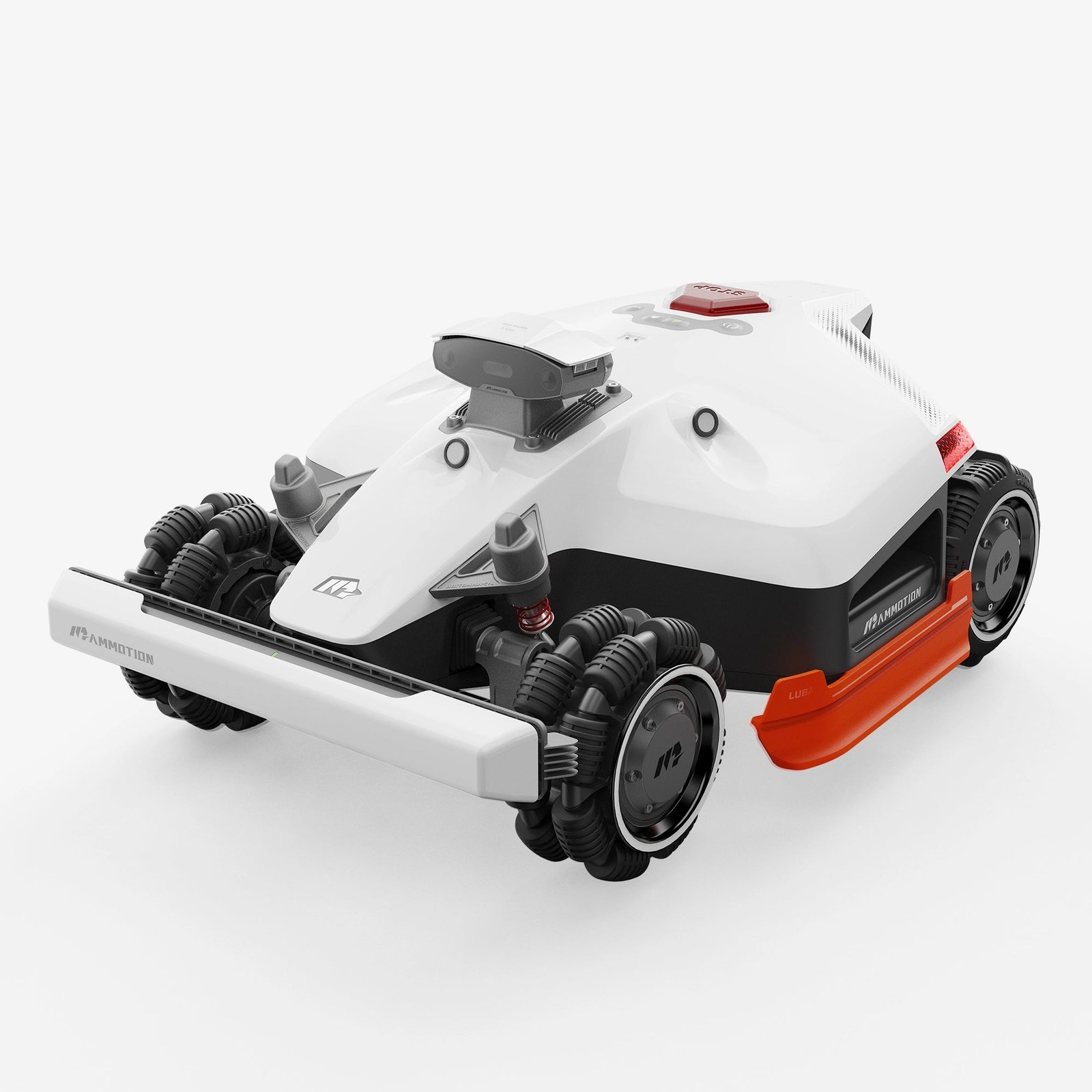
Mammotion Luba 2 3000HX
Wire-free (RTK+Vision) · Lawns up to 3/4 Acre · Slopes up to 80% · 15.7" cutting width
Check price at MammotionAnthbot Genie 1000
Wire-free (RTK+Vision) · Lawns up to 1/2 Acre · Slopes up to 45% · 7.9" cutting width
Check price at AnthbotMammotion Luba 2 5000HX
Wire-free (RTK+Vision) · Lawns up to 1 1/4 Acre · Slopes up to 80% · 15.7" cutting width
Check price at MammotionAnthbot Genie 3000
Wire-free (RTK+Vision) · Lawns up to 9/10 Acre · Slopes up to 45% · 7.9" cutting width
Check price at AnthbotAnthbot Genie 600
Wire-free (RTK+Vision) · Lawns up to 1/5 Acre · Slopes up to 45% · 7.9" cutting width
Check price at Anthbot